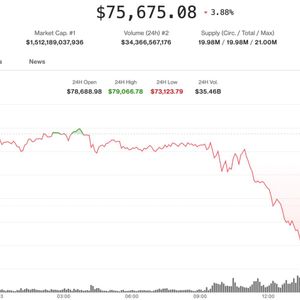
BitcoinWorld Crypto Futures Liquidated: Staggering $226 Million Wiped Out in One Hour Amid Market Turmoil Global cryptocurrency markets experienced a severe stress test today, with a staggering $226 million worth of futures contracts forcibly closed, or liquidated, within a single hour. This intense wave of liquidations, primarily affecting major exchanges like Binance, Bybit, and OKX, highlights the extreme volatility and inherent leverage risks within the digital asset derivatives sector. Consequently, traders globally are reassessing their risk parameters as the total 24-hour liquidation figure climbs to a concerning $527 million. Crypto Futures Liquidated: Anatomy of a Market Shock Futures liquidation represents a mandatory closure of a trader’s leveraged position by an exchange. This drastic action occurs when the trader’s initial margin, or collateral, falls below a required maintenance level. Essentially, the exchange sells the position to prevent losses from exceeding the deposited funds. The recent $226 million liquidation event, therefore, signifies a rapid and substantial price movement that breached critical support levels for thousands of highly leveraged trades. Market data indicates this liquidation surge coincided with a sharp 7% decline in Bitcoin’s price, which acted as the primary catalyst. Altcoins, known for their higher beta, experienced even more pronounced drops. This cascade effect is typical in leveraged markets, where initial liquidations trigger further selling pressure, potentially accelerating the downturn. Historical data from analytics platforms like Coinglass shows this ranks among the top ten hourly liquidation events of the past year. Understanding Derivatives and Market Mechanics To grasp the scale of this event, one must understand the cryptocurrency derivatives ecosystem. Unlike spot trading, where assets are bought and sold directly, futures contracts allow speculation on an asset’s future price. Traders can use leverage, often as high as 100x on some platforms, to amplify potential gains. However, this leverage also magnifies losses, making positions highly susceptible to liquidation during volatility. Long Positions Liquidated: The majority of the $226 million stemmed from long contracts, where traders bet on price increases. The sudden price drop vaporized their collateral. Short Positions Benefited: Conversely, traders holding short positions, betting on price declines, realized significant profits during this move. Funding Rate Dynamics: Prior to the drop, perpetual swap funding rates were significantly positive, indicating excessive bullish leverage. This created a crowded trade vulnerable to a swift unwind. Expert Analysis on Systemic Risk and Trader Psychology Market analysts point to several converging factors. First, macroeconomic uncertainty surrounding interest rate expectations created a fragile backdrop. Second, large over-the-counter (OTC) desk selling and the triggering of clustered stop-loss orders likely initiated the slide. According to common risk management frameworks, such events often flush out weak leverage and can establish healthier long-term support levels, albeit painfully for affected traders. Data from the past 36 months reveals a pattern: periods of low volatility and bullish sentiment frequently lead to leverage buildup. Subsequently, a single catalyst can trigger a deleveraging cycle. The $527 million 24-hour total, while significant, remains below the record $1.5 billion seen during the LUNA collapse in May 2022, providing context on the event’s relative severity. Impacts on Exchange Stability and Trader Behavior For cryptocurrency exchanges, managing liquidation events is critical for system stability. Automated liquidation engines must function smoothly to prevent insolvency. The fact that major platforms processed this volume without reported technical issues demonstrates improved infrastructure since earlier market cycles. However, such events invariably lead to increased scrutiny from regulators concerned about consumer protection in highly leveraged retail markets. For active traders, this event serves as a stark reminder of core principles. Effective risk management, including the use of stop-loss orders and conservative leverage ratios, is non-negotiable. Furthermore, understanding market sentiment through metrics like the Long/Short Ratio and Estimated Leverage Ratio can provide early warning signs of excessive crowding in one direction. Historical Context and Future Implications Comparing this event to past liquidation clusters offers valuable insights. The table below outlines key metrics from similar historical episodes: Date Primary Catalyst Max Hourly Liquidations 24-Hour Total May 2022 LUNA/UST Collapse $890M $1.5B November 2022 FTX Contagion $450M $1.1B August 2023 Spot ETF Delay News $310M $720M Current Event Macro Pressure & Leverage Unwind $226M $527M This historical perspective shows that while severe, the current stress event is not unprecedented. Market structure has evolved, with more institutional participation potentially providing deeper liquidity during dislocations. The long-term implication may be a maturation of the derivatives market, with exchanges potentially introducing more sophisticated risk tools or lower default leverage for retail users. Conclusion The liquidation of $226 million in crypto futures within one hour underscores the double-edged sword of leveraged derivatives trading. While offering profit potential, they introduce significant systemic fragility during volatility spikes. This event highlights the critical importance of robust risk management for traders and resilient infrastructure for exchanges. As the market digests this deleveraging, attention will turn to whether it has established a sustainable bottom or marks the beginning of a broader corrective phase. Ultimately, understanding the mechanics behind such crypto futures liquidated events is essential for anyone navigating the digital asset landscape. FAQs Q1: What does ‘futures liquidated’ mean? A futures liquidation is the forced closure of a leveraged trading position by an exchange. This happens when a trader’s losses deplete their collateral below the required maintenance margin, triggering an automatic sale to prevent further losses. Q2: Why did $226 million get liquidated in one hour? The mass liquidation was caused by a rapid, sharp drop in cryptocurrency prices, particularly Bitcoin. This move likely triggered a cascade of stop-loss orders and breached critical margin levels for thousands of highly leveraged long positions. Q3: Who loses money during a liquidation event? Traders whose positions are liquidated lose the collateral they posted for that trade. The exchange uses these funds to cover the loss on the contract. Counterparties on the winning side of the trade (e.g., short sellers during a price drop) profit. Q4: How can traders avoid being liquidated? Traders can avoid liquidation by using lower leverage, depositing additional collateral (margin) if prices move against them, and employing disciplined stop-loss orders to exit positions before a forced closure occurs. Q5: Do large liquidations signal a market bottom? Not necessarily. While large liquidations can flush out excessive leverage and sometimes precede a price rebound, they can also be mid-cycle events. They indicate a peak in panic selling but do not guarantee an immediate reversal; fundamental and technical factors must also be considered. This post Crypto Futures Liquidated: Staggering $226 Million Wiped Out in One Hour Amid Market Turmoil first appeared on BitcoinWorld .